Table Of Content
For example, expanded enrollment might occur due to a greater than anticipated attrition rate. Therefore, targeting C7 or C6 with the local anesthetic injection was effective in relieving shoulder pain, as demonstrated by other authors [12, 21,22,23]. This explains the superior postoperative analgesia provided by the erector spinae plane block compared to the intermediate cervical plexus block in the present study.
When group equality requires blocking on a large number of variables:
However, none of the papers in the above survey mentioned either the CR or the RB design by name, although these are the only designs suitable for general use. In most pre-clinical experiments inter-individual variation can be minimised by choosing animals which are similar in age and/or weight. They will have been maintained in the same animal house and should be free of infectious disease. So the research environment may be the main source of inter-individual variation. To estimate the efficiency that was gained by blocking (relative to completely randomized design).
ANOVA Summary Table
A survey of published papers using mice or rats was used to assess the use of CR, RB, or other named experimental designs. PubMed Central is a collection of several million full-text pre-clinical scientific papers that can be searched for specific English words. For example, the first ten papers had been published in 2017, 17, 19, 19, 19, 18, 15, 16, 19, and 18. And the first two digits of their identification numbers were 55, 55, 66, 65, 66, 59, 71, 61, 46 and 48. In order to introduce a random element to the selection, only papers with an even identification number were used.
A mobile app to challenge obsessional beliefs in adolescents: a protocol of a two-armed, parallel randomized ... - BMC Psychiatry
A mobile app to challenge obsessional beliefs in adolescents: a protocol of a two-armed, parallel randomized ....
Posted: Tue, 09 Apr 2024 07:00:00 GMT [source]
Randomized Block Designs
Randomized controlled experiments have a long history of successful use in agricultural research. A. Fisher in the 1920s as a way of detecting small but important differences in yield of agricultural crop varieties or following different fertilizer treatments8. Each variety was sown in several adjacent field plots, chosen at random, so that variation among plots growing the same and different crop varieties could be estimated. He used the analysis of variance, which he had invented in previous genetic studies, to statistically evaluate the results. Excessive numbers of randomised, controlled, pre-clinical experiments give results which can’t be reproduced1,2.
Geographic pair matching in large-scale cluster randomized trials - Nature.com
Geographic pair matching in large-scale cluster randomized trials.
Posted: Mon, 05 Feb 2024 08:00:00 GMT [source]
Statisticians involved in clinical trials sometimes write about “randomising patients to treatment groups”. Clearly, they are using the second definition as there are no physical groups in a clinical trial. But if scientists assign their animals to physical groups (“….things together”), they will be using the invalid “Randomisation to treatment group” (RTTG) design shown in Fig. Fisher noted that in any experiment there are two sources of variation which need to be taken into account if true treatment differences are to be reliably detected. First, is the variation among the experimental subjects, due for example, to the number of grains in a given weight of seed, or to individual variation in a group of mice.
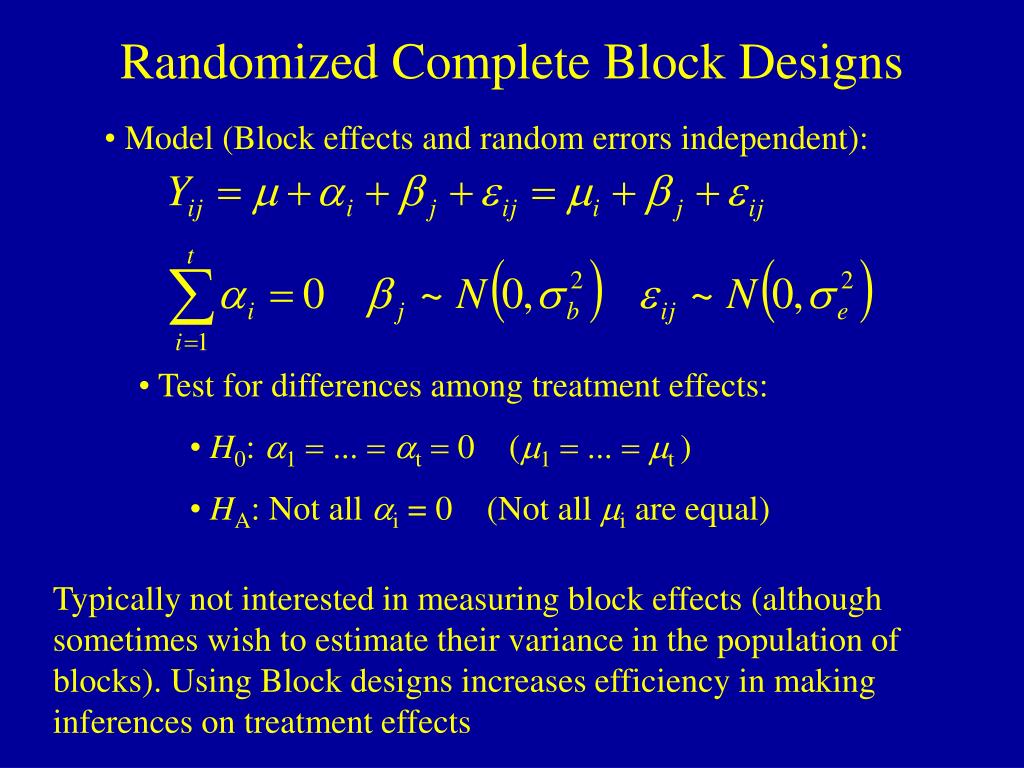
A randomized block design groups participants who share a certain characteristic together to form blocks, and then the treatment options get randomly assigned within each block. The cervical erector spinae plane block is a recently studied regional technique. However, there have been few studies conducted in the area of the current investigation. It is recommended to conduct further research to determine the optimal local anesthetic volumes and concentrations.
The origin of randomized controlled experiments
Second is the variation caused during the course of the experiment by the research environment and in the assessment of the results. Both types of variation must be controlled if bias and irreproducibility are to be avoided. A Completely randomized design uses simple randomization to assign participants to different treatment options (in general, a treatment group and a control group). If two or more animals are housed in the same cage they will interact, this can increase physiological variation. Even external factors such as barometric pressure can affect the activity of mice15.
Postoperative analgesia [11, 12, 20,21,22,23,24,25,26]
Fisher and others invented a few other named designs including the “Split plot”, the “Latin square” and the “Cross-over” designs. These can also be used in pre-clinical research in appropriate situations13, although they are not discussed here. Therefore, it would be very useful to block on gender in order to remove its effect as an alternative explanation of the outcome. And because physical capability differs substantially between males and females, the authors decided to block on gender. Engineering support by Patrick Burd, writing + comedic support by Megan Kard, and early explorations by Jonathan Kuei. And a special thanks to all the guinea pig beta testers in the Tradecraft design community.
The research environment is an important source of variation in pre-clinical research
In other words, when the error term is inflated, the percentage of variability explained by the statistical model diminishes. So if you don’t block, you will reduce the statistical power of the study. Performance time and onset time were shorter in the IC group and comparable with published data by Vloka, Hipskind [5, 14, 15]. No repetitive opioid doses had to be administered intraoperatively, which we interpret as sufficient regional anesthesia during surgery (duration maximum 90 min) [16,17,18,19]. The total number of patients who experienced postoperative complications such as nausea, vomiting, bradycardia, hypotension, phrenic paresis, and Horner's syndrome was similar between the two groups (P ≥ 0.05) (Table 3). The characteristics of the patients and the duration of surgery were similar between the two groups (Table 1).
As you have seen from the procedure described above, it shouldn't come as a surprise that it is very difficult to include many blocking variables. Also, as the number of blocking variables increases, we need to create more blocks. Each block has to have a sufficient group size for statistical analysis, therefore, the sample size can increase rather quickly. The selection of blocking variables should be based on previous literature. With small sample sizes, using simple randomization alone can produce, just by chance, unbalanced groups regarding the patients’ initial characteristics.
If this assumption is violated, randomized block ANOVA should not performed. One possible alternative is to treat it like a factorial ANOVA where the independent variables are allowed to interact with each other. Without the blocking variable, ANOVA has two parts of variance, SS intervention and SS error. All variance that can't be explained by the independent variable is considered error. By adding the blocking variable, we partition out some of the error variance and attribute it to the blocking variable. As a results, there will be three parts of the variance in randomized block ANOVA, SS intervention, SS block, and SS error, and together they make up SS total.

Staff may also become more proficient at handling animals, applying treatments, doing autopsies and measuring results during the course of an experiment, leading to changes in the quality of data. According to Montgomery9 “By randomization we mean that both the allocation of the experimental material, and the order in which the individual runs or trials of the experiment are to be performed, are randomly determined”. In this case, we would have four rows, one for each of the four varieties of rice.
In the present study, the time to first request for rescue analgesia was significantly shorter in the IC group compared to the ES group. Additionally, the total nalbuphine consumption was significantly higher in the IC group compared to the ES group. They can be used for any number of treatments and sample sizes as well as for additional factors such as both sexes or several strains of animals, often without increasing the total numbers. So, imagine each of these blocks as a rice field or patty on a farm somewhere. These blocks are just different patches of land, and each block is partitioned into four plots. Then we randomly assign which variety goes into which plot in each block.
A potential control variable would be driving experience as it most likely has an effect on driving ability. We will then divide up the participants into multiple groups or blocks, so that those in each block share similar driving experiences. For example, let's say we decide to place them into three blocks based on driving experience - seasoned; intermediate; inexperienced. Significant treatment imbalances and accidental bias typically do not occur in large blinded trials, especially if randomization can be performed at the onset of the study.
No patients required an additional dose of fentanyl beyond the initial dose in both groups. All blocks were conducted under sterile conditions in the operating room with sedation “midazolam 0.03–0.05 mg/kg as needed”. He wants to run an experiment since he has two kinds of corn and two types of fertilizer. Moreover, he knows that his plots are quite heterogeneous regarding sunshine, and therefore a systematic error could arise if sunshine does indeed facilitate corn cultivation. When in doubt, decide on the number of blocks based on previous literature.
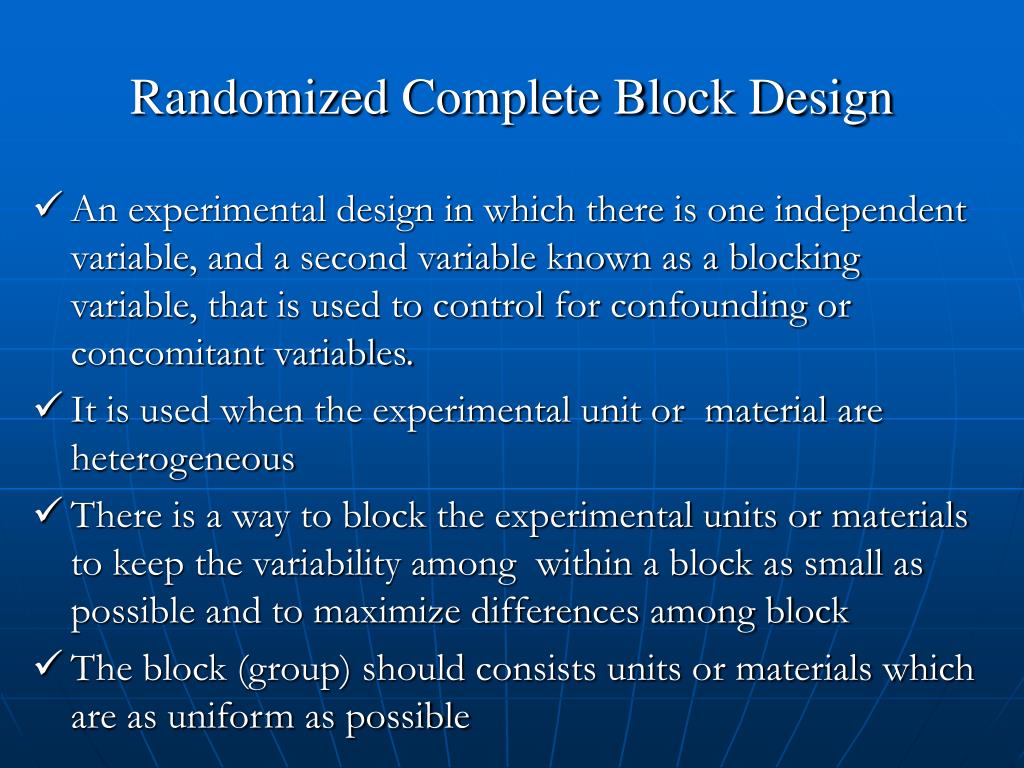
A randomized block design is an experimental design where the experimental units are in groups called blocks. The treatments are randomly allocated to the experimental units inside each block. When all treatments appear at least once in each block, we have a completely randomized block design. First, the blocking variable should have an effect on the dependent variable.


No comments:
Post a Comment